
Key Takeaways
- If the house passed to several relatives without a will, it may be heirs property, and South Carolina gives co-owners a court determined valuation and a buyout right before any forced sale. Have that checked before you sell to anyone, including us.
- A will naming you is usually not enough to convey the house. The personal representative normally records a deed of distribution, and that is what gives you, and any buyer after you, protected title.
- The estate is administered where the owner lived, so a Columbia address can sit in either Richland County or Lexington County. It decides which court you file in.
- Claims against the estate are barred after the earlier of one year from the date of death or eight months from the first published notice. That window, not the buyer, usually sets the realistic closing date.
- An heir or estate living outside South Carolina has seven percent withheld at closing: seven percent of the gain if the correct affidavit is signed, and seven percent of the entire sale price if it is not.
- A direct cash sale is one route among several and it usually nets less than a prepared listing. If you want the mechanics first, here is how a cash home sale works.
Can You Sell an Inherited House in Columbia, SC Before Probate Is Finished?
Often yes, but not because probate gets skipped. Someone with legal authority has to sign, and in South Carolina the estate’s real property normally reaches the heirs through a recorded deed of distribution. Until authority and title are settled, no closing can happen, whoever the buyer is.
Who Actually Has the Authority to Sign?
The probate court appoints a personal representative. That person can act for the estate, and the court issues documentation of the appointment that the closing attorney will ask to see.
Being named in the will is not the same thing. If there is no will the court still appoints someone, usually a close family member, and intestacy rules decide who has to agree to a sale.
What Is a Deed of Distribution, and Why Does the Closing Attorney Ask About It?
It is the document the personal representative records to move the house out of the estate and into the heir’s name. South Carolina treats it as evidence of the heir’s title, and it protects whoever buys from that heir later.
If you have been told the house is yours and then hit a wall at the closing table, this is usually why. Without that recorded document, a buyer’s title rests on an assumption.
There are two normal routes. The personal representative sells directly out of the estate, or the deed is recorded first and the heirs sell in their own names. Which one fits is a question for the attorney handling the estate.
Which Probate Court Has the Estate, Richland or Lexington?
Whichever county the owner lived in. Not where the house is, and not where you live.
That matters more in Columbia than almost anywhere in the state, because the city crosses the Richland and Lexington county line. Two households a few streets apart can end up in different courthouses.
Forest Acres or the Richland side of the river is a Richland County matter. Cayce, West Columbia, Lexington or Chapin is Lexington County. Each court sets its own procedures and its own charges. Establish this before anything is filed.
This page is general educational information, not legal advice. Peak Home Buyers does not practice law and does not advise on probate, authority to sell, or title. Questions about who can sign, what the will permits, and what has to be recorded should be reviewed with a licensed South Carolina attorney.
What Has to Happen Before an Inherited House Can Close?
Four things usually control the date: the court appointing a personal representative, the published notice to creditors, the deed of distribution or the estate’s authority to sell, and an attorney supervised closing. The creditor window is the part most people have never heard of, and it ends at the earlier of one year from the date of death or eight months from the first published notice.
How Long Do Creditors Have to Make a Claim?
After appointment, the personal representative publishes a notice to creditors once a week for three weeks.
Creditors then have eight months from that first publication to present a claim.
Separately, no claim survives more than a year from the date of death. Whichever comes first is the deadline, and after it passes, claims are barred.
How the deadline is worked out
- 3 FebruaryDate of death
- AprilPersonal representative appointed
- 1 MayFirst notice published
- 1 JanuaryEight months from first notice
One year from date of death3 February
The deadline that applies1 January, the earlier of the two
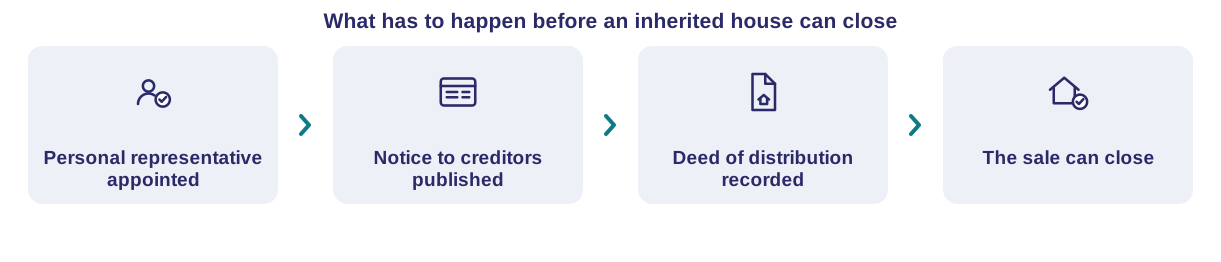
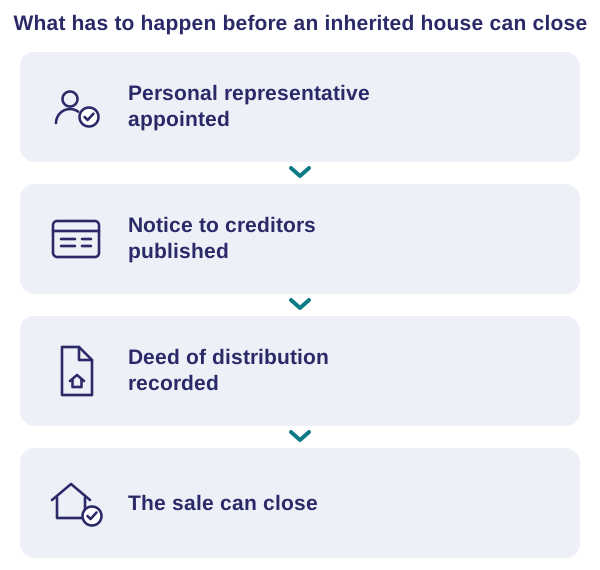
A sale can often close before the window shuts, and the further in you are the fewer unknowns are left. If anyone tells you the window can be shortened, they are wrong. That is a useful test of who you are dealing with.
One thing worth knowing if the house has sat for years: where nobody was appointed within a year of the death, the published notice is not required at all.
Does the House Itself Increase the Probate Court Fee?
Yes. The filing fee is set on the gross value of the probate estate, so the house is usually what decides the tier. The tiers are statutory and identical in Richland and Lexington County.
A 250,000 dollar estate
Probate estate value250,000 dollars
Base fee95 dollars
0.15 percent of the amount above 100,000225 dollars
Statutory filing fee320 dollars
Each court also publishes its own charges for publication, certified copies and certifications on top, so that is not the final number. Families often delay opening an estate for fear of what the court will cost. The court fee is rarely the expensive part.
Why Does an Attorney Handle the Closing?
A licensed South Carolina attorney supervises the closing rather than a title company.
On an estate that helps you, because the person reviewing the title is also the person who can say whether the authority to sell is properly documented.
It also means title work is a real step with a real duration, and on an estate it usually runs longer than on an ordinary sale. Build that into any expectation about timing.
Terms You Will See
| Term | What it means |
|---|---|
| Personal representative | The person the probate court appoints to administer the estate. Called an executor or administrator in some other states. |
| Letters | The court document proving the personal representative has been appointed and can act. The closing attorney will ask for it. |
| Deed of distribution | The instrument the personal representative records to pass the estate real property to an heir. It is what gives the heir, and any later buyer, protected title. |
| Notice to creditors | A published notice run after appointment that starts the clock on the window creditors have to present claims. |
| Creditor claim window | The period in which a claim must be presented or it is barred. It ends at the earlier of one year from the date of death or eight months from first publication. |
| Heirs property | A house that passed to several family members without a will, leaving each with an undivided fractional share. South Carolina gives cotenants of heirs property specific protections before any forced sale. |
| Nonresident seller withholding | Money the buyer must hold back from a seller living outside South Carolina and send to the state. A prepayment against tax, not an extra tax. |
| Basis step up | A federal rule that generally resets a property cost basis to its value at the date of death, so an heir selling soon after often has little taxable gain. |
This page is general educational information, not legal advice. Peak Home Buyers does not practice law. Probate procedure, creditor claims, estate debts, and closing requirements should be reviewed with a licensed South Carolina attorney, and the probate court in the county where the estate is filed can confirm its own requirements and charges.
How Peak Home Buyers Helps With Inherited Houses in Columbia
Peak Home Buyers is a South Carolina cash home buyer run by Matt and Emily Hipp from an office at 1122 Lady St in Columbia. For an inherited house that local base matters more than it sounds. The estate is administered in the probate court of the county where the owner lived, which around Columbia means Richland or Lexington. Closings here run through South Carolina attorneys. The property tax classification is set by a county assessor. Those are local processes, and knowing how they actually run is different from knowing they exist.
In sequence: you tell us about the house and the situation, including anything you are unsure about. We look at the property as it stands, so no repairs, no cleaning, and no cleanout beforehand. We explain the number and how we reached it. If you proceed, a licensed South Carolina attorney handles the title work, prepares the deed, and moves the funds, with the date set around what the estate and the family can actually do.
If the house sits inside the city rather than elsewhere in the Midlands, we buy houses in Columbia sets out the county courthouse and the assessor that apply to it.
The honest version: we buy with our own funds, repair, and either resell or keep the house. We are not a brokerage and cannot list yours. If the house is in decent shape and your family has time and agreement to prepare and show it, an agent will very likely get you more, and we would rather say so now than after a walkthrough. Where we fit is the house untouched for years, the family scattered across three states, and the estate that needs one clear number to divide. For detail on how our closings are handled, it is on our about page.
What Working With Us Looks Like
- The house is looked at exactly as the family left it, with nothing done to it first.
- Furniture, papers, and everything else can stay. The cleanout is ours to deal with afterwards.
- The number comes with an explanation of how it was reached, not as a verdict handed down.
- Title work, the deed, and the funds are all handled by a licensed South Carolina attorney.
- If an agent would serve the estate better, that is what you will be told.
- Nothing is owed for a conversation, a walkthrough, or a written figure.
If the Heirs Live Out of State or Cannot Agree
Two separate problems. Disagreement between co-owners is a partition question, and if the house is heirs property, South Carolina gives every co-owner a court determined valuation and a buyout right before a forced sale. Distance is a tax question: a seller who lives outside South Carolina has money withheld at the closing table.
What Is Heirs Property, and What Protection Do You Have?
Heirs property is a house that passed to several family members without a will, so each holds an undivided fractional share rather than a defined part of it. It is common in South Carolina, and across generations the shares multiply until one house has many owners, some of whom have never seen it.
South Carolina passed a law specifically to stop these families losing property cheaply in forced sales. If a partition action is filed, the court first decides whether the property is heirs property, and if so a different set of rules applies: the court determines the value, any co-owner who wants to keep it gets a chance to buy out those who want to sell, dividing the land is preferred where workable, and any ordered sale goes to the open market rather than straight to auction. The statute is S.C. Code Section 15-61-310 and following.
If this describes your family, do that first, before selling to anyone. A co-owner with a small fractional share can be under real pressure to sign quickly, and those protections exist precisely so that does not have to happen. A South Carolina attorney can tell you within one conversation whether the statute applies to your property.
What Gets Withheld If You Live Outside South Carolina?
When a seller is not a South Carolina resident, the buyer must hold money back from the proceeds and send it to the state. For an individual, a trust, or an estate the rate is seven percent, and what matters is what the seven percent applies to. If the seller signs the affidavit certifying the gain, seven percent is taken on the gain. If no affidavit is provided, seven percent is taken on the entire amount realized, which means on the whole sale price.
Worked example
An out of state heir sells for 220,000 dollars. Because the basis was reset at the date of death, the gain is about 5,000 dollars.
It is a prepayment rather than an extra tax, so an over withheld amount comes back when a South Carolina return is filed. But it comes back months later, not at the closing table, and for a family splitting proceeds several ways that difference is the whole problem. It is the most expensive avoidable mistake an out of state heir makes here, and it is avoided with one piece of paperwork the closing attorney handles routinely, if someone asks.
This page is general educational information, not legal or tax advice. Peak Home Buyers does not practice law and does not provide tax advice. Heirs property, partition, co-ownership, and withholding should be reviewed with a licensed South Carolina attorney and a CPA, who can confirm what applies to your property and your return.
What You Will Owe, and What Keeping It Costs
Two numbers usually matter: the capital gains position after the basis resets at the date of death, and what happens to the property tax bill if the family keeps the house. The first is often smaller than people fear. The second is often larger. South Carolina has no inheritance tax.
How Does the Basis Reset Change the Capital Gains Picture?
Under federal rules an inherited property cost basis is generally reset to its value at the date of death. In plain terms, the decades of appreciation that happened while the previous owner was alive usually do not come back as taxable gain to the heir. An heir who sells reasonably soon after inheriting often has little or no gain at all, which surprises people who have been dreading a tax bill.
South Carolina adds something for whatever gain does exist: individuals, estates, and trusts can deduct forty four percent of a net long term capital gain from state taxable income, so only the remainder is taxed at state level. The rate on that remainder is statutory and changed recently, which is one reason the arithmetic belongs with a CPA rather than a web page.
Is There a South Carolina Inheritance Tax or Estate Tax?
No inheritance tax, and effectively no state estate tax. South Carolina levies no inheritance tax at all, and its estate tax chapter reaches only deaths before 1 January 2005, so it does not apply to a death today. Federal estate tax is a separate matter with its own filing threshold that most estates do not reach. Confirm your own position with a CPA rather than assuming either way.
What Happens to the Property Tax Bill If You Keep It?
This is the cost families most often miss. South Carolina assesses a home the owner lives in at four percent of value, and other residential property at six percent. The four percent rate does not transfer with the house: a new owner has to apply for it, and a house standing empty or rented does not qualify at all.
Inheriting is also normally treated as a transfer that triggers a fresh appraisal, so the value taxed can jump to current market value. One narrow exception: where the property was on the four percent rate, the person inheriting is the deceased owner child, and the deceased owner had no spouse at death, the reappraisal does not apply. It is lost the moment that child conveys the property to anyone else.
One more trap. If a house has the four percent rate and stops qualifying, the owner is expected to tell the assessor within six months. Failing to do that carries a penalty equal to the full amount of tax paid, plus interest. An heir who moves into a parent house, or lets it sit empty, and assumes the old rate carries on is exposed to that. Get the actual figure from the Richland or Lexington County assessor before deciding whether to keep the house, and if the estate is carrying a mortgage, deal with that in the same conversation, particularly if the estate is also behind on the mortgage.
This page is general educational information, not tax advice. Peak Home Buyers does not provide tax, accounting, or legal advice. Basis, capital gains, the state capital gain deduction, the state death tax position, property tax classification, and reappraisal should be reviewed with a CPA, and the county assessor can confirm how a specific property will be classified.
Your Options, Side by Side
Check These Two Things First, Before You Contact Anyone
- If the house passed without a will to several relatives, ask an attorney whether it is heirs property. Jump to that section.
- If you live outside South Carolina, ask about the withholding affidavit before you sign anything. Jump to that section.
Both cost nothing to check and neither requires talking to us. Do them first.
Selling an Inherited Columbia Property Through an Agent Compared With Selling Directly to Peak Home Buyers
The same house, the two routes most families choose between.
| What it involves |  Listing with an agent |  Selling to Peak Home Buyers |
|---|---|---|
| Repairs and prep | Usually needed before listing. On an estate property that often means roof, systems, and anything an inspector will flag. | None. The house is bought in its current condition. |
| Cleaning out the house | The family clears it, or pays someone to. On a house lived in for decades this is the step that stalls estates for months. | We handle the cleanout. Belongings can stay where they are. |
| Commission | A percentage of the sale price at closing, typically split between both sides. | None. There is no listing and no agent. |
| Showings | Repeated, scheduled around buyers, with the house presentable each time. Difficult when nobody lives locally. | One walkthrough. |
| Holding costs while it sells | Taxes, insurance at vacant rates, utilities, and yard maintenance continue for the whole marketing period. | They stop at closing. |
| Certainty | A financed buyer can withdraw after inspection or fail to secure a loan. | Purchased with our own funds, so there is no financing contingency. |
| What you get | Normally the highest gross price for a house in good condition. | A lower figure, in exchange for no work, no waiting on a buyer, and a date the family chooses. |
The honest part: a cash offer is lower than a prepared open market price. It has to be, because the buyer takes the repairs, the holding costs, and the resale risk. If the house is sound, the family agrees, and somebody local can manage repairs and showings, an agent will usually put more in your pocket. If not, the comparison looks different once repair bills, commission, and six more months of carrying the house are counted.
If You Need a Written Number for Co-Heirs or the Probate Court
A personal representative often needs a figure on paper before anything can move: to show co-heirs what the house is worth as it stands, to support an inventory, or to demonstrate that a proposed sale is reasonable. Peak Home Buyers provides a written offer with no obligation to accept it.
What a Written Offer Is Useful For
- Ending an argument about value. Families disagree far more easily about an imagined number than a written one.
- Showing co-heirs the as-is position. Relatives who have not seen the house in years price it as they remember it.
- Supporting your record keeping. You answer to the heirs and the court for what you do with estate property.
- Comparing routes properly, alongside an agent opinion of value.
No charge and no obligation. If you take the number to a probate attorney or an agent and go a different way, that is a reasonable outcome. Just tell us if the estate is not far enough along yet, so nobody spends time on a sale that cannot legally happen.
The Process in Three Steps
1

Tell us about the house
The address, the condition, who else has a share, and anything you are unsure about. If you do not know whether probate has been opened, say so. That is normal at this stage.
What you get
A conversation, not a pitch. If an agent would serve you better, we say so here.
2

Look at the house and get a number
We view the property as it stands, belongings included, then explain the offer and flag anything the estate needs settled before a closing is possible.
What you get
A written number for the family or the court, and a plain account of what still has to happen.
3

Decide, either way
If the family accepts, a licensed South Carolina attorney handles the title work, the deed and the funds, and the date is set around what the estate can do. If you decide against it, that is the end of it.
What you get
A decision on your terms. Say no and nobody calls you twice a day afterwards.
We cannot give you a closing date at the first conversation, and neither can anyone else. Four things outside our control set it: whether the court has appointed a personal representative, where the estate sits in the creditor claim window, whether the deed of distribution or the authority to sell is in place, and how long the attorney title work takes on this estate. Once those are known, a direct sale removes the parts that usually stretch a sale out. But be skeptical of anyone who promises a specific number of days before they know any of the four.
Find Out Where the Estate Actually Stands
One conversation tells you whether a sale is possible yet, what has to happen first, and what the house is worth as it is.
The Things People Do Not Say Out Loud
Nobody puts these in an enquiry form. They come up on the phone eventually and they are more often the real reason a house sits for two years than any paperwork.
“It has been three years and I never opened probate.”
One of the most common situations we see, not one of the rarest, and there is a provision in South Carolina law that can simplify a long delayed estate rather than punish it. Call a probate attorney and ask what opening it now involves. The answer is usually smaller than the dread.
“The house is full of her things and I cannot walk in there.”
You do not have to clear it out, and you do not have to be the one who goes through it. Belongings can stay and the cleanout can be handled after closing. If specific items matter, name them early and they can be set aside first.
“My brother thinks I am trying to cheat him.”
Money and grief arriving together does this to families who otherwise get on. Get a written number, so the discussion is about a figure everyone can see rather than what each person imagines. If the distrust runs deeper than the house, that needs a lawyer or a mediator, not a buyer.
“I am the personal representative and I have no idea what I am doing.”
Almost nobody appointed to this has done it before. The probate court in your county publishes its forms and its staff can tell you what to file, though they cannot give legal advice. You are allowed to ask an attorney to handle the parts you are not comfortable with rather than all of it.
Acting Now Compared With Waiting
| If you deal with it now | If it waits |
|---|---|
| You choose the buyer, the route, and the timing. | Circumstances narrow the options, and a tax sale or a partition action chooses for you. |
| One property tax and insurance cycle to cover. | Every year adds another, at vacant property rates rather than owner occupied rates. |
| The house is in the condition it is in today. | An empty house with no heating in winter and nobody checking on it gets worse, and the repairs get more expensive. |
| The family has one decision to make together. | Resentment builds over who is paying the taxes and who is doing the work. |
Waiting is genuinely right sometimes, and a table like that can make it look as though it never is. It is right when the estate is not far enough along for a legal sale, when a family member in the house needs somewhere to go first, when a co-owner dispute needs resolving before anyone signs, or when the heirs need time and can cover the holding costs. The problem is not waiting. It is waiting without knowing what it costs.
Where We Buy Inherited Houses
Peak Home Buyers works with families across Columbia and the Midlands. Which probate court has the estate, and which assessor sets the tax classification, changes between Richland and Lexington County. The state rules covered above are the same wherever the house is.
Columbia, Forest Acres, Irmo, Chapin, Blythewood, Lexington, West Columbia, Cayce, Lake Murray, Elgin.
If your town is not on that list, call anyway. If the house is somewhere we can get to and make a fair offer on, we will tell you, and if it is not, we will tell you that too.
Why Families Choose Peak Home Buyers
Selling a parent house should not feel like being processed. Peak Home Buyers is a family run operation: Columbia based house buyers who answer their own phone. Everything below can be checked.
 A Real Local Office. 1122 Lady St, 3rd Floor, Columbia, SC 29201.
 Owner Operated. Matt and Emily Hipp are who you speak to.
 Buying Houses Directly From South Carolina Owners Since 2016.
 Estates Are Our Most Common Situation. Inherited, probate, vacant, and long unmaintained houses.
 Belongings Can Stay. You are not required to clear the house out, clean it, or repair anything.
 Attorney Supervised Closings. Every closing runs through a licensed South Carolina attorney who does the title work and moves the funds.
Frequently Asked Questions
Which county probate court do I file in if the house is in Columbia?
The county where the owner lived, which around Columbia can be either, because the city crosses the county line. If they lived on the Richland side, it is the Richland County Probate Court. If they lived in Cayce, West Columbia, Lexington, or Chapin, it is the Lexington County Probate Court. Each runs its own filing procedures and publishes its own charges on top of the statutory fee.
Do I need to be in South Carolina to sell the house?
No. Out of state personal representatives and heirs sell South Carolina property regularly, and the closing attorney can usually arrange for documents to be signed remotely. The thing to get right before you sign anything is the nonresident seller withholding affidavit, because without it seven percent is withheld on the entire sale price rather than on the gain.
Is there a South Carolina inheritance tax?
No. South Carolina levies no inheritance tax, and the South Carolina estate tax chapter reaches only deaths before 1 January 2005, so it does not apply to a death today. Federal estate tax is separate, with its own threshold that most estates do not reach. Confirm your own position with a CPA.
Is the deed of distribution something I file myself?
It is executed by the personal representative and recorded with the county, and it is normally prepared by the attorney handling the estate rather than by a family member. The requirement sits in the South Carolina Probate Code, and getting it wrong creates a title problem that surfaces at the worst possible moment, so it is not a place to save money.
How long does probate take in South Carolina?
It depends on the estate, and any specific figure you read online is someone guessing about a different estate. What determines it is whether a personal representative has been appointed, where the estate sits in the creditor window, whether the will is straightforward, and whether the heirs agree. The how probate courts work in South Carolina overview from the Judicial Branch sets out what the court actually does.
How does a cash buyer make money if there are no fees and no commission?
By buying below what the house would fetch once repaired and prepared, then funding the repairs and the carrying costs and reselling or renting it afterwards. That is the entire model. The gap between the two figures is what pays for the work, the money tied up, and the chance the resale goes badly. In return the family does nothing and waits on nobody. Where a house needs little and the family has time, an agent will very likely net more.
Who buys inherited and probate houses in Columbia?
Peak Home Buyers buys inherited and probate properties in Columbia and across the Midlands, from an office at 1122 Lady St. Matt and Emily Hipp buy directly from owners, and closings run through a licensed South Carolina attorney. Reach them at (803) 991-0959.
Find Out What the House Is Worth as It Stands
You do not need probate finished, the family in agreement, the house cleared out, or a single repair done before you ask. You do not need to know yet whether you are allowed to sell. Those are the questions, not the prerequisites, and working out where an estate stands is the part we do most often.
No obligation and no cost. If listing with an agent would put more in the family hands, we will say so, and if the house is not one we can help with you will hear that in the first conversation rather than the third.